Tracing Italian Lineages of Adoptees and Ancestors Born Outside Marriage
Investigative and genealogical research pertaining to adopted ancestors or those ancestors born outside marriage presents particular challenges. While each case is unique, certain generalities can be considered based upon the nature of social conditions, as well as available records. For the most part, we shall consider such generalities as related to civil (vital statistics) records, as opposed to church records (parochial acts of baptism, marriage, etc.). Historical topics relate to births from circa 1810 to circa 1860; subsequent births will be said to be contemporary, births in the twentieth century being considered investigative cases rather than genealogical research projects per se.
Before embarking on any project involving an adoptive ancestor or one born outside marriage, it is important that the researcher acknowledge and comprehend several factors. From 1860 until 1929, the Italian state (i.e. the Kingdom of Italy) did not recognize Catholic marriages. Although it is true that both ecclesiastical and civil marriages were performed for most spousal unions in certain parts of Italy (such as the Kingdom of the Two Sicilies) in the decades before 1860, the Kingdom of Italy refused to recognize ecclesiastical marriages altogether. This means that an act of birth from, for example, 1875, might refer to a child as the son of "an unwed mother" who in fact was married in church but not at the town hall. Terms of one of the Lateran Treaties granted retroactive state recognition of these ecclesiastical marriages in 1929. Therefore, such acts must be confirmed by consultation of parochial records.
Hearsay may provide certain general information, but its legitimate research value usually correlates in some way (often inversely) to its social value. For example, an unwed mother might have claimed, perhaps long after her child's birth and far away from the locality where she resided when she gave birth, that the natural father was a local aristocrat; families often perpetuated such stories to salvage the dignity of both mother and child. The genealogist, however, would require more than a merely circumstantial "allegation" of paternity in such a case--for example, a formal act of recognition made by the natural father before the local vital statistics registrar.
An act of recognition would not have "legitimized" such a child for purposes such as succession to a title of nobility, though it may have allowed him, if only under very particular conditions, to inherit certain other paternal property, but in any event a married man would not likely consent to acknowledge publicly that he had committed adultery or fornication. The principle of legitimacy relates to crown (statutory) and church (canon) laws too complex to be described in detail here. Illegitimacy in Italy has never been as rigidly defined as in English law, which distinguishes, for example, between "bastards" and "adulterine bastards." Canon law formerly dictated that only legitimately-born men could be ordained to the priesthood, but this condition is no longer required for ordination. Rigid privacy laws prohibit direct consultation of contemporary (post-1910) vital statistics records, or any such records that have not been deposited with a provincial state archive.
Historical Cases
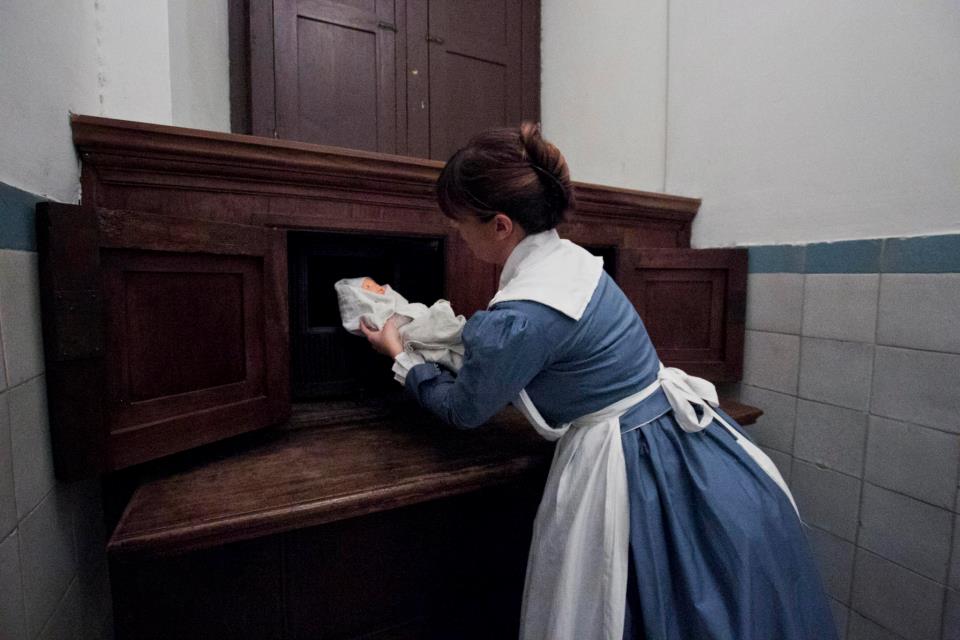
Into the nineteenth century, foundlings were often given surnames which actually indicated their illegitimacy. Proietti meant "cast out," Trovato literally meant "foundling," and D'Ignoti "of unknown" parents. Esposito derived directly from the Latin ex positum (literally "of this place") which appeared in some acts of baptism of foundlings. Legislation passed in 1928 outlawed the practice of assigning such children surnames indicative of their illegitimacy or abandonment, but surnames of some sort still had to be given to these children. These were sometimes the surnames of royal and noble families, but more often they were toponymic (geographical) in nature or alluded to the day, month or season of the child's birth (i.e. Sabato, Maggio, Primavera, and so forth).
An act of birth referring to an infant's paternity as "unknown" was normally necessary if the mother was unwed and the natural (biological) father had not come forth to recognize the child. Reference to "unknown" maternity was more frequent in the cases of complete abandonment of infants; this doesn't necessarily imply that all such infants were born to unwed parents. Where this kind of declaration was made by a midwife, it is reasonable to presume that she knew the identify of the woman whose baby she helped to deliver. It is presumed that the mother declaring the birth of her own illegitimate child knew who fathered the baby.
The texts of acts of baptism usually indicated "legitimate and natural" children of listed parents, and "natural" progeny of a single parent (usually the mother) or unknown parents.
Acts of recognition may be contained in particular registers covering a number of years, or they may be found in , which may also include adoptions and sundry legal acts relating in some way to vital statistics. It should be observed that atti diversi registers are not dedicated exclusively to adoptions and unwed births. In some localities, there are particular registers dedicated exclusively to proietti, or foundlings. Most frequently, acts of births regarding to foundlings or children born to unwed mothers were filed in the same registers as other births.
Contemporary Cases
After 1860, civil acts of birth were instituted throughout Italy, whereas previously they were kept only in certain regions or were attached to acts of baptism. In general, acts of birth and marriage after 1860 provide far less genealogically useful information than will be found in acts issued prior to that date.
In considering this period, it is worth noting that Italian orphanages traditionally were sponsored by the religious orders, and therefore answered to the church before the state. Very few of their archives have been preserved for consultation, and in the event usually do not provide the explicit information (such as parentage) that facilitates lineal research. However, many children were placed in orphanages who were not "orphans" in the most traditional sense. For example, a man whose wife died might place his children in an orphanage even though they were no longer infants (for instance, children around the age of ten years).
In the event an infant were placed for adoption (for example, by a young unwed mother) after his birth was registered, the birth record itself might include parentage, or at least indicate maternity. However, direct consultation of such acts, which may be prohibited even to most vital statistics personnel, is usually impossible, and only a "simple" birth certificate (without indication of parentage) normally will be issued. In fact, most birth certificates issued in Italy today, and all those required for official use such as school registration, are released on forms which do not even have a designated space for parents' names. This is likewise true for most contemporary baptismal certificates.
In certain cases, an infant was placed for adoption immediately, even before his birth was registered. In such cases, the birth records would contain less information.
Twentieth-century adoptions, including many of those processed after 1946, have often been undertaken through various Catholic agencies; this included newborns as well as children resident in orphanages, and until the 1970s some such adoptions were "international" (i.e. Italian-born children placed with overseas couples). Certain information pertinent to such adoptions would be retained by the agencies (many of which are now defunct) and, in most cases, by the local court responsible for registration of adoptions. Unfortunately for adoptees in search of their natural parents, such records are usually not made available for consultation.
Circumstantial Evidence and Investigations
Circumstantial factors must be considered objectively in cases involving foundlings, adoptees and children born outside marriage. In the rare instances when conclusions are drawn, these must be based upon a preponderance of the evidence, and all evidence must have been reviewed carefully. This may involve parochial records as well as civil ones, and will normally require direct consultation of records in Italy, as opposed to superficial review of microfilmed records.
Sociological factors and practices are extremely important in this particular branch of genealogical research, and bureaucratic procedures (regarding access to records, etc.) are relevant. In most cases, the research involving a project of this nature should be entrusted to a professional genealogist based in Italy who is experienced in investigations and studies of this kind. Especially in contemporary cases concerning living persons, such investigations may necessitate the application of certain particular strategies and tactics which have not been described herein.